
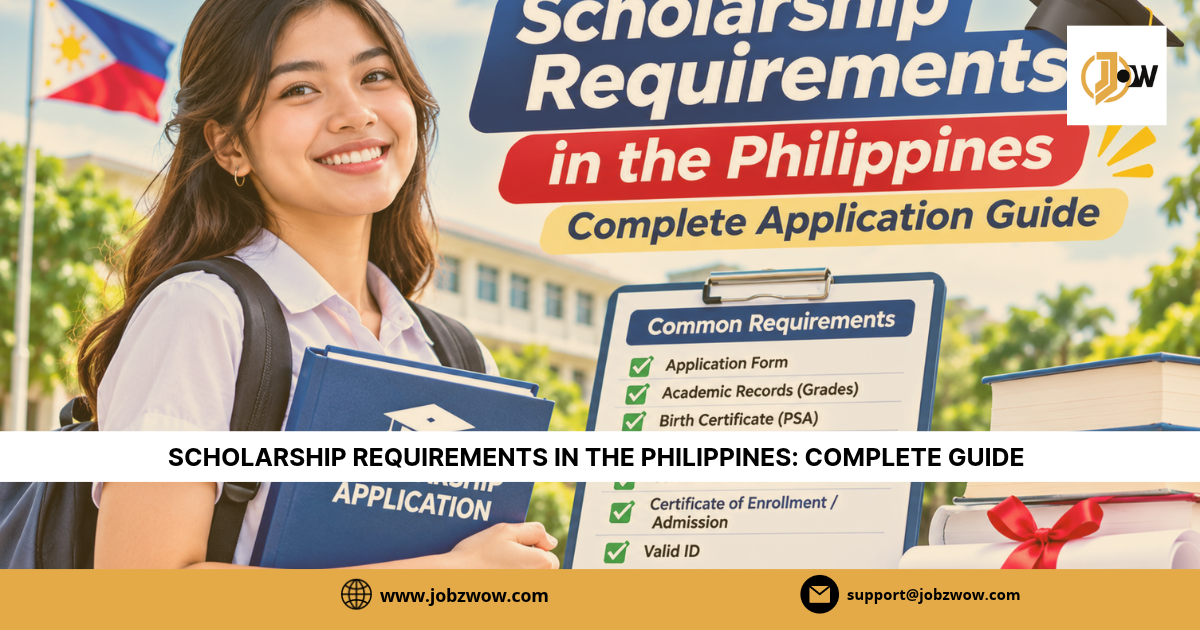
Scholarship Requirements in the Philippines: Complete Application Guide
Applying for a scholarship can help students manage the cost of college, university, or technical education. However, one of the most common reasons scholarship applications are delayed or rejected is incomplete or incorrect documentation.
If you are a student in the Philippines looking for financial assistance, understanding the common scholarship requirements before applying can save time and help you prepare a stronger application.
This guide explains the documents students may need, how to prepare them, common eligibility requirements, and important mistakes to avoid.
What Are Scholarship Requirements?
Scholarship requirements are the qualifications and documents that a student must meet or submit to be considered for financial assistance.
Every scholarship program has its own rules. Requirements can depend on:
- Academic performance
- Family income
- Educational level
- Degree or course
- Citizenship
- School or university
- Scholarship type
- Special eligibility categories
Because requirements can change between application periods, students should always check the latest instructions from the official scholarship provider before submitting an application.
Common Scholarship Requirements in the Philippines
Although every program is different, many scholarships commonly ask for some combination of the following documents.
1. Proof of Filipino Citizenship
Many government scholarship programs require applicants to be Filipino citizens.
A birth certificate issued by the Philippine Statistics Authority (PSA) may be requested as proof of identity and citizenship.
Make sure the information on your documents is accurate and consistent with your application.
2. School Report Card or Academic Records
Academic records are among the most common scholarship requirements.
Depending on the program, applicants may need:
- Senior high school report card
- Form 138 or equivalent school record
- Certificate of grades
- Transcript of records
- Latest semester grades
- Certificate of academic standing
Some scholarships have minimum grade requirements, so students should carefully review the academic criteria before applying.
3. Proof of Family Income
Need-based scholarships may require documents showing the financial situation of the applicant’s family.
Possible documents can include:
- Income Tax Return (ITR)
- Certificate of Tax Exemption
- Certificate of Non-Filing
- Certificate of Indigency
- Proof of income
- Social case study report
- Other documents accepted by the scholarship provider
The exact document required depends on the scholarship program and the applicant’s circumstances.
4. Certificate of Good Moral Character
Some scholarship programs may ask for a Certificate of Good Moral Character from the student’s school.
This document generally confirms that the student has maintained acceptable conduct while attending the institution.
If it is required, request it early because school processing times can vary.
5. Certificate of Enrollment or Admission
Students who have already been accepted or enrolled in a college or university may need to provide proof of admission or enrollment.
This may include:
- Certificate of enrollment
- Admission letter
- Registration form
- Enrollment certificate
- Proof of acceptance
Some scholarships require applicants to enroll in specific courses or recognized institutions.
6. Application Form
Most scholarship programs require an official application form.
When completing the form:
- Use your legal name
- Provide an active email address
- Use a working mobile number
- Enter your academic information accurately
- Check your family information carefully
- Review all answers before submitting
Do not provide false information simply to meet an eligibility requirement.
7. Identification Documents
Some scholarship providers may request additional identification documents.
Depending on the program, applicants may be asked for:
- School ID
- Government-issued ID
- Valid identification document
- Parent or guardian identification
- Other proof of identity
Only submit documents specifically requested by the scholarship provider.
Scholarship Requirements for Different Students
Requirements can vary depending on your situation.
Requirements for Senior High School Students
Students applying for undergraduate scholarships may commonly need:
- School report card
- Proof of grades
- Birth certificate
- Good moral certificate
- Proof of family income, when required
- Application form
- Other documents specified by the scholarship
Requirements for College Students
Current college students may need:
- Certificate of enrollment
- Latest grades
- Transcript of records
- Birth certificate
- Proof of income
- School identification
- Scholarship application form
Some scholarships are specifically designed for incoming first-year students, while others accept students who are already enrolled.
Requirements for Technical-Vocational Students
Students applying for technical-vocational scholarships may have different requirements depending on the training program and scholarship provider.
Applicants should check the specific TESDA or training institution requirements before preparing their documents.
Academic Requirements for Scholarships
Academic requirements are different for every scholarship.
Some programs are primarily merit-based and require strong grades. Others may place greater emphasis on financial need, specific courses, community circumstances, or other eligibility criteria.
Before applying, check:
- Required GWA or grade average
- Required subjects or courses
- Eligible degree programs
- Grade level
- Academic standing
- School eligibility
- Other program-specific conditions
Meeting the minimum academic requirement does not necessarily guarantee selection because some scholarships use ranking or competitive selection.
Income Requirements
Some scholarships consider the financial situation of the applicant’s family.
Income requirements may be used to determine whether a student qualifies for need-based assistance.
If income documentation is required, make sure the information is current and consistent across your documents.
Never alter income documents or submit false information.
Scholarship Requirements for Special Groups
Some scholarship programs provide consideration or additional opportunities for specific groups.
Depending on the program, applicants may include:
- Students from low-income families
- Persons with disabilities
- Indigenous Peoples
- Orphans
- Solo-parent families
- First-generation college students
- Children of qualified workers or specific sectors
If you belong to a special eligibility group, the scholarship provider may request additional certificates or supporting documents.
How to Prepare Scholarship Documents
Preparing documents early can make the application process much easier.
Step 1: Read the Official Requirements
Start by reading the complete scholarship announcement or application guidelines.
Do not rely only on Facebook posts, screenshots, or forwarded messages.
Step 2: Create a Document Checklist
Make a checklist of every required document.
For example:
- Application form
- Birth certificate
- School records
- Proof of income
- Good moral certificate
- Enrollment/admission document
- Identification
- Additional supporting documents
Step 3: Request School Documents Early
Some documents can take time to obtain from your school.
Request them before the application deadline whenever possible.
Step 4: Check Names and Information
Your name, date of birth, school information, and other important details should be consistent across documents.
Step 5: Scan Documents Clearly
If the application is online, make sure scanned documents are:
- Clear
- Complete
- Readable
- Properly oriented
- In the required file format
- Within the allowed file size
Avoid uploading blurry photographs of important documents.
Step 6: Keep Backup Copies
Save copies of everything you submit.
Keep your documents in a secure folder so you can access them if the scholarship provider requests verification.
Common Scholarship Application Mistakes
Even qualified students can experience problems because of avoidable mistakes.
Submitting an Incomplete Application
Missing one required document can affect your application.
Using Incorrect Information
Double-check names, dates, grades, addresses, and other details before submitting.
Missing the Deadline
Scholarship applications usually have specific submission periods. Late applications may not be accepted.
Uploading Unreadable Documents
A blurry or incomplete document can make verification difficult.
Applying for the Wrong Program
Always confirm that your course, school, year level, and other qualifications match the scholarship.
Relying on Unofficial Information
Scholarship details can change. Always verify the latest information through the official scholarship provider.
How to Improve Your Scholarship Application
Meeting the basic requirements is the first step. You can also improve your application by:
- Maintaining strong academic performance
- Preparing documents early
- Following instructions carefully
- Keeping your information accurate
- Using a professional email address
- Checking your application before submission
- Applying to multiple legitimate scholarships when allowed
- Preparing for interviews or examinations when required
How to Verify a Scholarship Is Legitimate
Students should be careful when searching for scholarships online.
Before applying, check:
- Who is providing the scholarship?
- Does the organization have an official website?
- Is the announcement published through an official channel?
- Are the eligibility requirements clearly explained?
- Is the application process transparent?
- Does the organization request suspicious payments?
- Does the application ask for unnecessary sensitive information?
Be especially careful with scholarships that promise guaranteed approval in exchange for money.
Frequently Asked Questions
What documents are usually required for scholarships in the Philippines?
Common documents may include a birth certificate, academic records, proof of income, good moral certificate, application form, and proof of enrollment or admission. Requirements vary by scholarship.
Do all scholarships require high grades?
No. Some scholarships are primarily merit-based, while others consider financial need or other eligibility factors.
Can college students apply for scholarships?
Yes, but eligibility depends on the specific program. Some scholarships are for incoming first-year students, while others accept currently enrolled college students.
Do I need a Certificate of Good Moral Character?
Some scholarship programs require it, while others do not. Always check the specific application guidelines.
Can I apply for multiple scholarships?
You may be able to apply for multiple scholarships, but accepting more than one government-funded scholarship or financial assistance program may be restricted under the rules of certain programs. Check the conditions of each scholarship before accepting an award.
What should I do if I do not have one of the required documents?
Check the scholarship provider’s official instructions to see whether an alternative document is accepted. Do not submit a fake or altered document.
- Best Scholarships in the Philippines for College Students
- OJT and Internship in the Philippines: Complete Student Guide
- How to Write a Professional CV: Complete Guide for Job Seekers
- How to Prepare for a Job Interview: Complete Guide
- 20 Common Job Interview Questions and How to Answer Them
Final Checklist Before Submitting
Before clicking the submit button, make sure:
- Your application form is complete
- Your name is spelled correctly
- Your academic records are accurate
- Required documents are attached
- Scanned files are readable
- Income documents are included when required
- Your email address and phone number are correct
- You meet the eligibility requirements
- You have checked the deadline
- You have saved a copy of your application
Final Thoughts
Preparing scholarship requirements early can make the application process easier and reduce the risk of missing important documents.
The most important thing is to follow the specific requirements of the scholarship you are applying for. Government scholarship programs such as CHED and DOST can have different eligibility rules, documents, academic requirements, and application procedures.
Always verify the latest information through the official scholarship provider before submitting personal documents.
For more education, scholarship, internship, career, and job-search guidance, continue exploring the Scholarships & Internships section on JobzWow.