
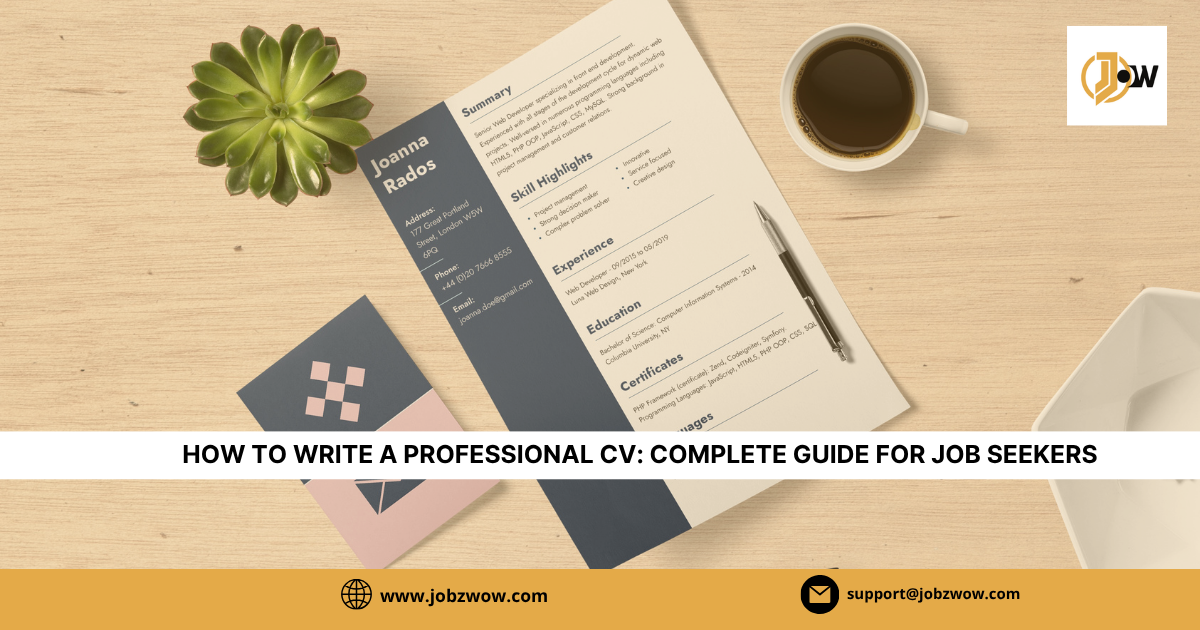
How to Write a Professional CV: Complete Guide for Job Seekers
A professional CV is one of the most important tools in a job search. It gives an employer a quick overview of your education, experience, skills, achievements, and suitability for a position.
However, writing a good CV is not simply about listing everything you have ever done. A strong CV presents the most relevant information clearly, honestly, and in a format that makes it easy for an employer to understand your background.
Whether you are a fresh graduate applying for your first job or an experienced professional looking for a better opportunity, this guide explains how to write a professional CV and avoid common mistakes.
What Is a CV?
A CV, or Curriculum Vitae, is a document that summarizes your professional and educational background.
Depending on the position and employer, a CV may include:
- Contact information
- Professional summary
- Education
- Work experience
- Skills
- Certifications
- Projects
- Achievements
- Languages
- Relevant additional information
The information included should be relevant to the job you are applying for.
How to Avoid Fake Job Advertisements: 10 Warning Signs
Career & Job Guidance: Complete Guide to Finding the Right Job
Why Is a Professional CV Important?
Recruiters and employers may receive many applications for the same position. A clear CV helps them quickly understand whether your background matches the role.
Your CV should answer three basic questions:
- Who are you?
- What experience and skills do you have?
- Why are you relevant to this particular position?
A professional CV does not guarantee an interview, but a clear and relevant application can make it easier for an employer to evaluate your qualifications.
1. Start With Your Contact Information
Place your basic contact information near the top of the CV.
Usually, this can include:
- Full name
- Phone number
- Professional email address
- City and country
- Professional LinkedIn profile, if relevant
- Portfolio or professional website, if relevant
Make sure your contact information is accurate.
Use a Professional Email Address
Avoid using an email address that looks inappropriate or overly casual for professional communication.
A simple format based on your name is usually easier for employers to recognize.
2. Write a Clear Professional Summary
A professional summary is a short introduction that explains your background and the type of value you can bring to an employer.
For an experienced professional, it can mention:
- Years or type of experience
- Main area of expertise
- Important skills
- Professional focus
For a fresh graduate, it can focus on:
- Degree or field of study
- Relevant skills
- Projects or internships
- Career interests
Example for an Experienced Candidate
Professional Summary
Administrative professional with experience in office operations, documentation, customer communication, and computer-based administrative tasks. Skilled in MS Office, data management, communication, and maintaining organized records.
Example for a Fresh Graduate
Professional Summary
Recent graduate with a background in business and strong communication, computer, and organizational skills. Interested in an entry-level position where I can apply my academic knowledge, develop practical experience, and contribute to a professional team.
Keep your summary specific rather than filling it with generic phrases such as “hardworking,” “punctual,” or “self-motivated” without supporting information.
3. Add Your Work Experience
Work experience is often one of the most important sections of a CV.
For each relevant position, include:
- Job title
- Company or organization
- Employment dates
- Important responsibilities
- Relevant achievements, where applicable
List your most recent relevant experience first.
Focus on Responsibilities and Results
Instead of writing:
Responsible for social media.
A more informative description could be:
Managed social media content and supported digital campaigns across multiple platforms, including content scheduling, audience engagement, and performance monitoring.
Whenever you have genuine measurable results, include them accurately.
For example:
Improved monthly social media engagement by 25% through a revised content strategy.
Never invent numbers simply to make your CV look more impressive.
4. Highlight Relevant Skills
The skills section should reflect abilities that are genuinely useful for the position.
Depending on your career, these may include:
- Microsoft Office
- Communication
- Customer service
- Data entry
- Digital marketing
- Content writing
- Project management
- Data analysis
- Graphic design
- Programming
- Problem-solving
- Teamwork
- Time management
Avoid creating an extremely long list of unrelated skills.
A shorter list of relevant and demonstrable skills is usually more useful.
5. Include Your Education
Add your educational qualifications in a clear format.
You can include:
- Degree or qualification
- Institution
- Field of study
- Graduation year, where appropriate
For example:
Bachelor of Computer Science
ABC University
2024
If you are a recent graduate with limited work experience, your education and academic projects may deserve more space.
6. Add Relevant Certifications
Professional certifications can strengthen a CV when they are relevant to the position.
Examples may include certifications in:
- Information technology
- Digital marketing
- Project management
- Microsoft Office
- Data analysis
- Language skills
- Industry-specific training
Include the certification name, issuing organization, and completion date when useful.
Do not add certificates that you have not actually completed.
7. Include Projects When They Demonstrate Your Skills
Projects can be especially useful for students, graduates, freelancers, and people changing careers.
A project section may include:
Project Name
Brief explanation of what you created or accomplished.
Tools/Skills: Relevant tools or technologies used.
Result: Explain the outcome where measurable and accurate.
Personal projects can demonstrate practical ability even when you have limited formal employment experience.
8. Customize Your CV for Each Job
One of the most useful CV practices is to make the document relevant to the position.
Before applying, read the job description carefully.
Identify:
- Required skills
- Main responsibilities
- Required qualifications
- Relevant experience
- Important tools or technologies
Then make sure your CV clearly presents the qualifications you actually possess that match those requirements.
For example, if a company is hiring a customer service representative, relevant communication, customer handling, problem-solving, and support experience should be easy to find.
If you are applying for an IT position, technical skills and relevant projects may deserve greater emphasis.
9. Keep the CV Easy to Read
A professional CV does not need complicated graphics.
Use:
- Clear headings
- Consistent fonts
- Appropriate spacing
- Short paragraphs
- Bullet points
- Consistent formatting
Avoid using too many colors, decorative elements, unusual fonts, or large graphics that make important information difficult to find.
Your CV should look professional while remaining easy to scan.
10. Keep Information Accurate
Never exaggerate your qualifications.
Avoid:
- Fake experience
- Fake certifications
- False job titles
- Invented achievements
- Incorrect employment dates
- Skills you cannot actually demonstrate
An inaccurate CV can create problems during interviews or employment verification.
Honest information presented effectively is better than exaggerated information.
11. Common CV Mistakes to Avoid
Before sending your CV, check for common problems.
Spelling and Grammar Errors
Typos can make your application appear careless.
Read the CV carefully before submitting it.
Too Much Unnecessary Information
A CV does not need every detail about your life.
Focus on information that helps demonstrate your suitability for the role.
Generic CV for Every Job
A single CV may not communicate your most relevant qualifications for every position.
Customize important sections when appropriate.
Poor Formatting
Inconsistent fonts, spacing, headings, and dates can make a CV difficult to read.
Unprofessional Email Address
Use an email address suitable for professional communication.
False Information
Never invent qualifications or experience.
Long Blocks of Text
Use concise descriptions and bullet points where they improve readability.
12. How Long Should a CV Be?
There is no universal page length that works for every candidate.
The appropriate length depends on:
- Your experience
- Career level
- Industry
- Job requirements
- Relevant achievements
A fresh graduate may have a relatively short CV because they have less professional experience.
An experienced professional may reasonably need more space to explain relevant roles and achievements.
The goal should be relevance and clarity, not reaching a specific page count.
13. CV Tips for Fresh Graduates
If you have little or no professional experience, don’t assume that you have nothing to include.
You can highlight:
- Education
- Internships
- Academic projects
- Relevant coursework
- Certifications
- Volunteer work
- Freelance work
- Technical skills
- Student activities relevant to the position
Focus on evidence that demonstrates your ability to learn and contribute.
14. CV Tips for Experienced Professionals
Experienced professionals should focus on the experience most relevant to their target role.
Instead of describing every responsibility from every job, emphasize:
- Relevant accomplishments
- Major projects
- Leadership experience
- Specialized skills
- Measurable results
- Industry knowledge
This makes it easier for employers to understand the value of your experience.
15. Use Action-Oriented Language
When describing professional experience, choose clear action words where appropriate.
Examples include:
- Managed
- Developed
- Created
- Organized
- Coordinated
- Analyzed
- Implemented
- Supported
- Improved
- Led
- Prepared
- Maintained
However, only use an action word if it accurately describes what you actually did.
16. Check Your CV Before Sending It
Use a final checklist before submitting an application.
CV Checklist
☐ Name and contact information are correct.
☐ Email address is professional.
☐ Work dates are accurate.
☐ Education information is correct.
☐ Relevant skills are included.
☐ Spelling and grammar have been checked.
☐ Formatting is consistent.
☐ Information is relevant to the position.
☐ No false information has been included.
☐ The correct CV file has been attached.
☐ The file opens correctly before submission.
Taking a few minutes to review your application can help prevent avoidable mistakes.
Frequently Asked Questions
What should I include in a professional CV?
A professional CV can include contact information, a summary, education, relevant work experience, skills, certifications, projects, and achievements.
Should a fresh graduate include work experience?
If you have internships, part-time work, freelance projects, volunteer experience, or other relevant experience, include it when it supports your application. Academic projects and relevant skills can also be useful.
Should I customize my CV for every job?
It is useful to tailor your CV for relevant positions by highlighting the experience and skills that genuinely match the job description.
How long should a CV be?
There is no single page length that applies to every candidate. Keep it focused on relevant information and make it easy to read.
Should I include a photo on my CV?
Photo requirements vary by country, industry, employer, and position. Follow the application instructions and local professional norms rather than automatically adding a photo to every CV.
Should I include every skill I have?
No. Focus on relevant skills that you actually possess and can demonstrate.
Can students use projects instead of work experience?
Yes. Relevant academic, personal, freelance, or volunteer projects can demonstrate practical skills, particularly when formal employment experience is limited.
Final Thoughts
A professional CV should make your qualifications easy to understand, not overwhelm the employer with unnecessary information.
Start with accurate contact details, write a clear summary, present relevant experience, highlight genuine skills, and customize the document for suitable opportunities. Then review the final CV carefully before submitting it.
Remember that a CV is not simply a list of everything you have done. It is a focused presentation of the experience, skills, education, and achievements that are relevant to your next career opportunity.
At JobzWow, our goal is to provide practical career and job guidance that helps job seekers prepare better applications, identify genuine opportunities, and make informed career decisions.